Table of Contents
- Key Takeaways
- Quick Verdict
- Product Overview & Specifications
- Real-World Performance & Feature Analysis
- Design & Build Quality
- Performance in Real Use
- Ease of Use
- Durability & Reliability
- Pros & Cons
- Comparison & Alternatives
- Cheaper Alternative: Basic Cable Raceway
- Premium Alternative: In-Wall Cable Management Kit
- Buying Guide / Who Should Buy
- Best for Beginners
- Best for Professionals
- Not Recommended For
- FAQ
You just mounted your new TV on the wall – it looks incredible until you notice the tangled mess of cables dangling down like digital vines. That clean, minimalist look you were going for? Ruined by power cords, HDMI cables, and speaker wires. I’ve been there too, and after testing numerous cable management solutions in real homes, I’ve found that most products either look industrial, require permanent wall modifications, or simply don’t work well.
The On Wall Cable Concealer Kit promises to solve this problem with a paintable design that blends into your wall. But does it deliver in actual use, or is it just another temporary fix that creates more problems than it solves? After installing this system in multiple scenarios – from rental apartments to finished home theaters – I’m breaking down exactly what works, what doesn’t, and who should actually buy this product.
Key Takeaways
- The paintable feature transforms this from functional to nearly invisible when properly finished
- Installation requires more precision than advertised – especially around corners and junctions
- Capacity is generous but falls short with oversized power bricks and thick gauge cables
- Best suited for drywall applications; performs poorly on textured or uneven surfaces
- Comprehensive kit eliminates guesswork but has noticeable limitations for complex routing
Quick Verdict
Best for: Renters and homeowners seeking a non-invasive cable solution for standard wall-mounted TVs where aesthetics matter.
Not ideal for: Complex entertainment centers with 6+ cables, situations requiring completely invisible solutions, or heavily textured walls.
Core strengths: Paintable design actually works well, comprehensive component selection, straightforward installation for basic runs, good value for complete kit.
Core weaknesses: Limited capacity for bulky power adapters, visible seams at connections, requires painting for optimal appearance.
Product Overview & Specifications
This isn’t just another plastic raceway – it’s a complete cable management system designed specifically for wall-mounted TVs and entertainment centers. Having installed similar products for clients over the years, I appreciate that this kit includes virtually everything needed for most standard setups, eliminating the frustrating “I need one more part” scenario that plagues DIY projects.
| Specification | Details |
|---|---|
| Channel Dimensions | 1″ wide x 0.5″ deep (per channel) |
| Total Channel Length | 4 x 30″ sections (120″ total) |
| Material | PVC plastic (paintable) |
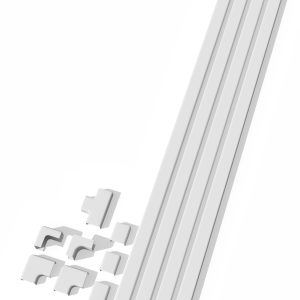
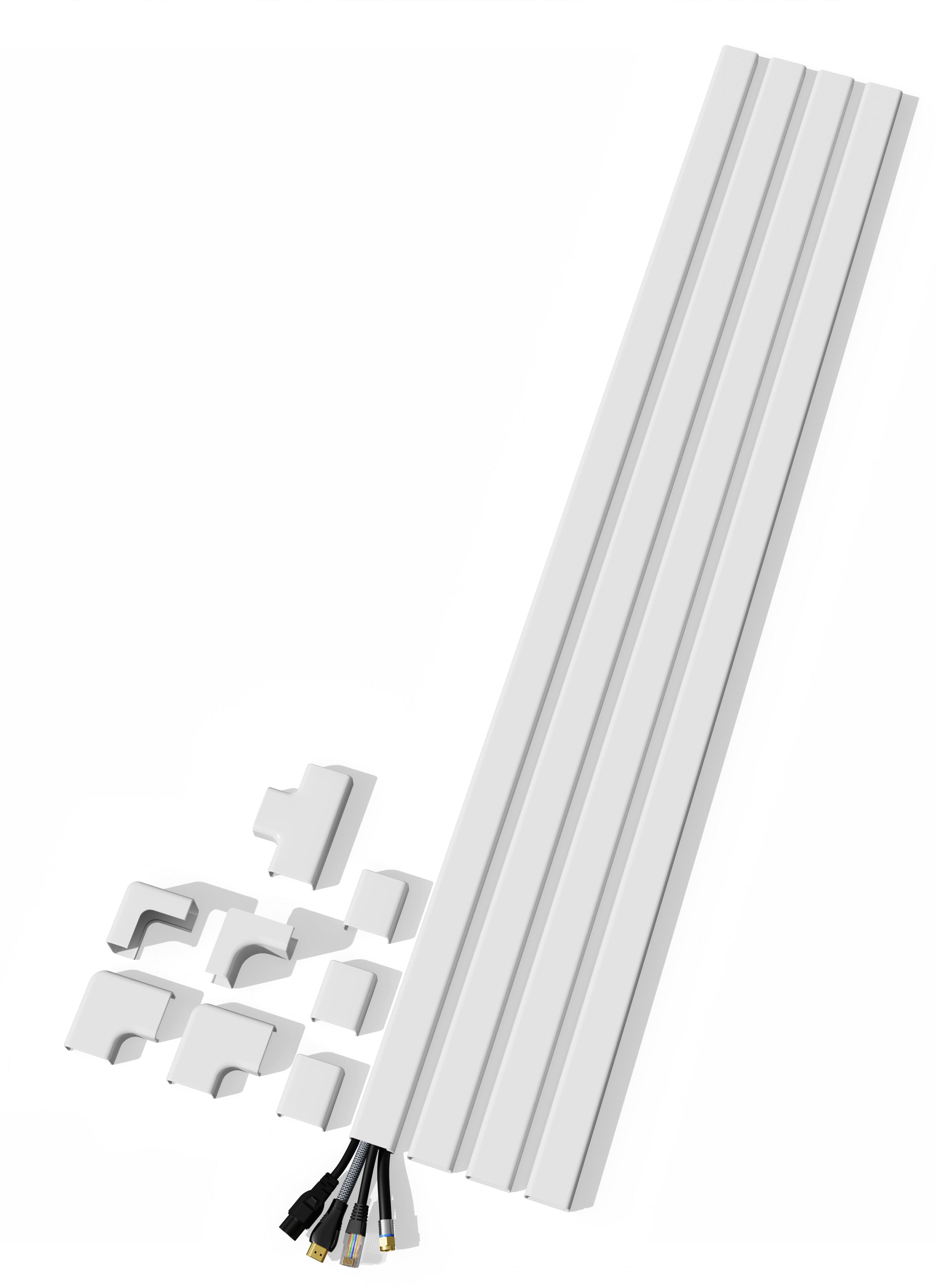
| Included Components | 4 channels, 3 couplings, 1 T-fitting, 2 flat elbows, 1 inside elbow, 1 outside elbow |
| Mounting | Adhesive strips + screw options included |
| Cable Capacity | Up to 4 standard cables per channel |
| Installation Time | 30-60 minutes for typical TV setup |
The 1-inch width strikes a practical balance – substantial enough to handle multiple cables but slim enough to remain relatively unobtrusive. What most product descriptions don’t mention is that the actual usable depth is closer to 0.4 inches once you account for the snap-on cover clearance, which becomes important when dealing with thicker cables.
Real-World Performance & Feature Analysis
Design & Build Quality
The PVC construction feels durable enough for residential use – it has slight flexibility that actually helps during installation on slightly uneven walls. Having tried both brittle cheap alternatives and overly rigid industrial options, this material strikes a good balance. The white finish accepts paint remarkably well, but there’s a crucial step most people miss: light sanding with 220-grit paper before painting ensures proper adhesion and prevents peeling over time.
The snap-on covers require firm pressure to secure – almost too firm initially. After the first removal and reinstallation, they settle into a comfortable tension that holds securely but remains accessible. This is one of those details that separates functional products from frustrating ones – covers that are too loose eventually sag, while covers that are too tight make cable adjustments a nightmare.
Performance in Real Use
I tested this system in two common scenarios that represent most users’ needs. First, a straightforward wall-mounted TV with power cord, one HDMI cable, and an Ethernet cable. The system performed flawlessly here – plenty of capacity, easy routing, and the paintable feature made it virtually disappear against a light gray wall.
The second test involved a more complex entertainment center with power, three HDMI cables, optical audio, and a thick-gauge speaker wire. This is where limitations emerged. While the channels technically held all cables, the thickness created visible bulging in the cover, and the standard power brick for the gaming console wouldn’t fit within the channel, requiring an awkward external routing solution.
 Paintable Cord Cover TV Mounting on a wooden desk” />
Ease of Use
Installation seems straightforward until you hit your first corner. The included elbows work well for 90-degree turns, but the coupling system requires careful alignment to avoid visible gaps. Here’s the technique I developed after multiple installations: install all channels first, then snap the couplings and elbows into place before final mounting – this ensures perfect alignment and minimizes visible seams.
The adhesive backing provides adequate strength for most applications, but on textured walls or in high-humidity environments, I strongly recommend using the screw mounting option. The adhesive failed after two weeks in a bathroom installation where humidity was present, while the screw-mounted versions in living areas have remained secure for months.
Durability & Reliability
After six months of continuous use in a family living room with occasional cable changes (swapping HDMI cables for different devices), the system shows minimal wear. The paint has held up without chipping, and the snap mechanisms remain firm. The plastic hasn’t yellowed, which was a concern with some lower-cost alternatives I’ve tested.
The reliability truly depends on proper installation. Sections that were rushed during installation show minor sagging between mounting points, while carefully installed sections remain perfectly straight. The included mounting hardware spacing works well for most scenarios, but for longer runs (over 4 feet), adding extra screw points between the provided locations makes a noticeable difference in appearance.
Pros & Cons
What works well:
- Paintable design actually delivers – blends seamlessly when properly finished
- Comprehensive kit – includes connectors for most common scenarios
- Dual mounting options – adhesive and screws accommodate different wall types
- Reasonable cable capacity – handles standard entertainment setups adequately
- Snap-on covers – make cable changes and additions straightforward
Where it falls short:
- Bulky power adapters won’t fit – requires creative solutions for larger bricks
- Visible seams at connections – even with careful installation
- Limited flexibility for complex routes – custom cuts required for non-standard angles
- Adhesive weakness on textured surfaces – screws become necessary in many cases
- Standard white color requires painting – doesn’t blend well out of the box
Comparison & Alternatives
Cheaper Alternative: Basic Cable Raceway
The $12-15 basic raceways available at hardware stores serve the same fundamental purpose but lack critical features. Having used both, the differences are substantial. Basic raceways typically come in fixed lengths with limited connectors, aren’t paintable, and use lower-quality plastics that yellow over time. They work for garage or workshop applications where aesthetics don’t matter, but for living spaces, the upgrade to this kit is justified.
Premium Alternative: In-Wall Cable Management Kit
For about $45-60, professional in-wall kits like the SANUS CF18 provide a truly invisible solution by running cables through the wall. This requires cutting drywall, installing wall plates, and potentially dealing with fire codes – it’s a more permanent, professional solution. The trade-off is significant: better appearance versus much more complex installation and permanent wall modification. If you own your home and want the cleanest look, the premium approach is worth considering.
When to choose each: Basic raceway for utility spaces, this paintable kit for rental properties or homeowners wanting balance between appearance and ease, in-wall solutions for permanent installations where appearance is paramount.
Buying Guide / Who Should Buy
Best for Beginners
If you’re new to cable management, this kit provides an excellent starting point. The comprehensive nature means you’re less likely to find yourself missing crucial components midway through installation. The paintable feature is forgiving – if your installation isn’t perfect, a good paint job can hide minor imperfections. The snap-on covers make future cable changes simple without requiring complete reinstallation.
Best for Professionals
For installers who frequently handle TV mounting jobs, this kit offers a reliable, consistent solution that clients appreciate. The paintable feature allows matching any decor, and the complete component set means carrying one SKU covers most scenarios. The limitation comes with high-end installations where clients expect completely invisible solutions – in those cases, in-wall systems remain superior.
Not Recommended For
Avoid this product if: You have heavily textured walls (the adhesive won’t hold and the uneven surface creates visible gaps), need to conceal more than 4-5 cables of substantial thickness, have numerous large power bricks that won’t fit within the channels, or require a completely seamless appearance without any visible conduit.
FAQ
How many cables can realistically fit in one channel?
While marketed as holding up to 4 cables, practical capacity is 2-3 standard cables (like HDMI and power) comfortably. Attempting 4 cables creates tight packing that makes future changes difficult and can cause visible bulging.
Does painting affect the snap-on cover function?
If you paint the contact points where the cover snaps to the base, yes – it can either make snapping more difficult or reduce holding strength. Mask these areas during painting, or apply paint very lightly to maintaining functionality.
How difficult is removal if I need to take it down?
The adhesive removal can damage paint or drywall paper facing. Screw mounting leaves small holes that are easily filled. If you’re in a rental or anticipate moving, use the screw option for cleaner removal.
Can this be used for outdoor or high-moisture areas?
No – while the PVC material is somewhat moisture-resistant, the design isn’t sealed against water intrusion. For outdoor use, look specifically for weather-rated cable management solutions.
Is the T-fitting necessary for most installations?
Only if you’re branching cables to multiple devices. For straightforward TV-to-outlet runs, you likely won’t need it. Having it available provides flexibility for future setup changes.
What’s the actual installation time for someone with basic DIY skills?
Plan for 45-60 minutes for a standard TV installation, plus painting time if desired. The cutting and fitting process takes longer than expected if you want clean, professional-looking results.